Six Ecstasy pills were found in Mr. Birnbaum’s knapsack, and he was handcuffed and placed under arrest. Mr. Birnbaum later agreed to enter a multiyear, pretrial diversion program that has involved counseling and drug tests, as well as visits to Alabama every six months to update a judge on his progress.
But once he is done, Mr. Birnbaum’s record will be clean. Which means that by the time he graduates from the University of Texas at Austin, he can start his working life without taint.
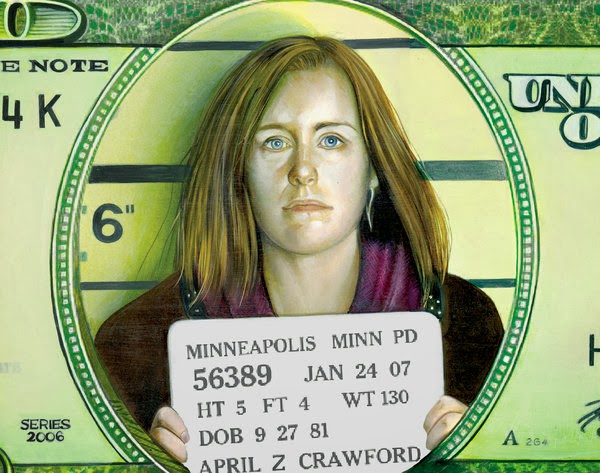
At least in the eyes of the law. In the eyes of anyone who searches for Mr. Birnbaum online, the taint could last a very long time. That’s because the mug shot from his arrest is posted on a handful of for-profit Web sites, with names like Mugshots, BustedMugshots and JustMugshots. These companies routinely show up high in Google searches; a week ago, the top four results for “Maxwell Birnbaum” were mug-shot sites.
The ostensible point of these sites is to give the public a quick way to glean the unsavory history of a neighbor, a potential date or anyone else. That sounds civic-minded, until you consider one way most of these sites make money: by charging a fee to remove the image. That fee can be anywhere from $30 to $400, or even higher. Pay up, in other words, and the picture is deleted, at least from the site that was paid.
To
Mr. Birnbaum, and millions of other Americans now captured on one or
more of these sites, this sounds like extortion. Mug shots are merely
artifacts of an arrest, not proof of a conviction, and many people whose
images are now on display were never found guilty, or the charges
against them were dropped. But these pictures can cause serious
reputational damage, as Mr. Birnbaum learned in his sophomore year, when
he applied to be an intern for a state representative in Austin. Mr.
Birnbaum heard about the job through a friend.
“The
assistant to this state rep called my friend back and said, ‘We’d like
to hire him, but we Google every potential employee, and the first thing
that came up when we searched for Maxwell was a mug shot for a drug
arrest,’ ” Mr. Birnbaum said. “I know what I did was wrong, and I
understand the punishment,” he continued. “But these Web sites are
punishing me, and because I don’t have the money it would take to get my
photo off them all, there is nothing I can do about it.”
It
was only a matter of time before the Internet started to monetize
humiliation. In this case, the time was early 2011, when mug-shot Web
sites started popping up to turn the most embarrassing photograph of
anyone’s life into cash. The sites are perfectly legal, and they get
financial oxygen the same way as other online businesses — through
credit card companies and PayPal. Some states, though, are looking for
ways to curb them. The governor of Oregon signed a bill this summer that
gives such sites 30 days to take down the image, free of charge, of
anyone who can prove that he or she was exonerated or whose record has
been expunged. Georgia passed a similar law in May. Utah prohibits
county sheriffs from giving out booking photographs to a site that will
charge to delete them.
But
as legislators draft laws, they are finding plenty of resistance, much
of it from journalists who assert that public records should be just
that: public. The Reporters Committee for Freedom of the Press argues
that any restriction on booking photographs raises First Amendment
issues and impinges on editors’ right to determine what is newsworthy.
That right was recently exercised by newspapers and Web sites around the
world when the public got its first look at Aaron Alexis, the Navy Yard
gunman, through a booking photograph from a 2010 arrest.
“What we have is a situation where people are doing controversial things with public records,” says Mark Caramanica, a director at the committee, a nonprofit organization based in Arlington, Va. “But should we shut down the entire database because there are presumably bad actors out there?”
MUG shots have been online for years, but they appear to have become the basis for businesses in 2010, thanks to Craig Robert Wiggen, who served three years in federal prison for a scheme to lift credit card numbers from diners at a Tex-Mex restaurant in Tallahassee, Fla. He was looking for another line of work, according to news articles, and started Florida.arrests.org.
The idea soon spread, and today there are more than 80 mug-shot sites. They Hoover up most of their images from sheriffs’ Web sites, where rules and policies about whose mug shot is posted and for how long can vary, from state to state and from county to county.
The sites are designed for easy ogling. Some feature a running scroll of the famous (Lindsay Lohan), the infamous (James E. Holmes, accused in the Aurora, Colo., mass shooting) and the obscure but colorful (a man with an American flag painted on his face and bald head).
The owners of these sites can be hard to find, or at least to reach on the phone. An exception is Arthur D’Antonio III, 25, founder of JustMugshots, which is based in Nevada (though he declined to be more specific). Mr. D’Antonio was eager to combat any suggestion that there was something illicit or unethical about the mug-shot posting business in general and his Web site in particular.
“No one should have to go to the courthouse to find out if their kid’s baseball coach has been arrested, or if the person they’re going on a date with tonight has been arrested,” he said. “Our goal is to make that information available online, without having to jump through any hoops.”
A few years ago, one of Mr. D’Antonio’s friends turned up on a mug-shot Web site, and Mr. D’Antonio, who has been earning good money writing software code since he was 12, spotted a business opportunity. JustMugshots began in 2012 and now has five employees, two of whom spend all their time dredging up images from 300 sources. The site has nearly 16.8 million such photos, according to Mr. D’Antonio. He would not discuss revenue or profit, except to say, “We’re seeing some growth.”
JustMugshots has a “courtesy removal service,” allowing people who have been exonerated, or never charged, or even those who can demonstrate that they have turned around their lives, to get their image taken down free. Mr. D’Antonio declined to say how many people had been granted mercy deletions.
The opposite case — a person who is guilty of a terrible crime and has the money to remove his or her face from the Web site — presents another sort of quandary. If the point of JustMugshots is to inform the public, why should the rich and convicted get a pass?
“That’s where it gets tricky,” Mr. D’Antonio said. “We review paid orders and we have refunded paid orders, if, after doing some research, it becomes clear that there is a reason to do so.”
He would not say how many times JustMugshots has returned money of a customer deemed too awful to delete. Nor did he seem uncomfortable being the arbiter of who is shadowed by a mug shot and who is not. He also passed on the opportunity to be photographed for this article. Better to keep a low profile, he said.
Having his face online could create problems.
JUSTMUGSHOTS is one of several sites named in a class-action lawsuit filed last year by Scott A. Ciolek, a lawyer in Toledo, Ohio. Mr. Ciolek argues that the sites violate Ohio’s right-of-publicity statute, which gives state residents some control over the commercial use of their name and likeness. He also says the sites violate the state’s extortion law.
“You can’t threaten to embarrass someone unless they pay you money,” he said, “even if they did exactly what you are threatening to embarrass them about.”
Lance C. Winchester, a lawyer in Austin who represents BustedMugshots and MugshotsOnline, both named in the lawsuit, says Mr. Ciolek’s lawsuit is a stinker because the United States Supreme Court has ruled time and again that mug shots are public records.
“I understand people think there is a dilemma presented by a Web site where you can pay to have a mug shot removed,” he said. “I understand that people don’t like to have their mug shots posted online. But it can’t be extortion as a matter of law because republishing something that has already been published is not extortion.”
Like JustMugshots, the Web sites operated by Mr. Winchester’s clients also say they will take down an image, at no charge, for qualified supplicants. But many who qualify for this pass to get off the site free don’t use it, largely because they don’t believe that the offer is real. One of them is Dr. Janese Trimaldi, 40, a physician who recently completed her residency in Tampa, Fla.
On a terrifying evening in July 2011, she says, she locked herself in her bedroom to hide from a drunken, belligerent boyfriend. He went into the kitchen, retrieved a steak knife and jimmied open the door.
“He was more than 6 feet tall, and weighed 250 pounds,” she said by phone in Tampa. “I’m 5 feet and at the time I weighed about 100 pounds. So when he got in, he lifted me by my arms, the way you lift a child, and threw me six feet backward.”
The screams and commotion caused a neighbor to call the police. The boyfriend — whom Dr. Trimaldi did not want named for fear that he would stalk her — contended that a bleeding scratch on his chest had been inflicted by Dr. Trimaldi with the knife. (It was from one of her fingernails, she says.) She was arrested and charged with aggravated assault with a deadly weapon and battery domestic violence.
The state dropped the charges, according to a document signed by Mark A. Ober, the state attorney in Hillsborough County, Fla. A few months later, her booking photograph turned up on a Florida mug-shot Web site and with it another mug shot from a 1996 arrest on an accusation of possession of marijuana and steroids. The authorities had raided her apartment on suspicion that a different boyfriend — this one a bodybuilder — was illegally selling the steroids. Records show that she was quickly released, and a certificate of disposition from the 13th Judicial Circuit of Florida shows that she was not prosecuted for either charge.
She paid $30 to have the images taken down, but they soon appeared on other sites, one of which wanted $400 to pull the picture.
“I’ve read accounts of people paying and not having the photos removed,” she said. “Or they pay and appear on other sites. The whole thing is a racket.”
Now studying for her medical boards and $200,000 in student loan debt, she is gearing up for a job search and worries that two photographs could wreck years of hard work to practice medicine.
“If I wasn’t a level-headed, positive person,” she wrote in an e-mail to Mr. Ciolek, the lawyer in Toledo, “I would have seriously considered ending my own life.”
LEGISLATORS have heard dozens of stories like Dr. Trimaldi’s and scrambled for remedies. Jennifer Williamson, an Oregon state representative from Portland, helped to draft her state’s bill, and she is the first to acknowledge that it is far from ideal.
“All approaches have significant shortcomings,” she said, referring to laws in other states. “I don’t know what the perfect tool is, but I’m sure we’ll be back at the drawing board soon.”
The trick is balancing the desire to guard individual reputations with the news media’s right to publish. Journalists put booking photographs in the same category as records of house sales, school safety records and restaurant health inspections — public information that they would like complete latitude to publish, even if the motives of some publishers appear loathsome.
The Reporters Committee for Freedom of the Press favors unfettered access to the images, no matter how obscure the arrestee and no matter the ultimate disposition of the case. Even laws that force sites to delete images of the exonerated, the committee maintains, are a step in the wrong direction.
“It’s an effort to deny history,” says Mr. Caramanica, the committee director. “I think it’s better if journalists and the public, not the government, are the arbiters of what the public gets to see.”
People eager to vanish from mug-shot sites can try a mug-shot removal service, a mini-industry that has sprung up in the last two years and is nearly as opaque as the one it is intended to counter. “I’m not going to go into what we do,” said Tyronne Jacques, founder of RemoveSlander.com (Motto: “Bailout of the Internet for good!”). “Whatever works.”
Removal services aren’t cheap — RemoveMyMug.com charges $899 for its “multiple mug shot package” — and owners of large reputation-management companies, which work with people trying to burnish their online image, contend that they are a waste of money.
“Their business model is to find someone willing to pay to take down their image, which marks them as a target who is willing to pay more,” says Mike Zammuto, president of the reputation company Brand.com.
Princess Matthews, a mother of four who lives in Toledo, tried the budget approach to remove mug shots from a handful of sites. During a tumultuous period in her life, she was arrested on charges ofassault, drug possession and theft, among other crimes. All but one of the charges — for attempted petty theft — were expunged or classified as criminal mischief, she says.Now out of an abusive relationship, she is starting a nonprofit group called Project No More Pain, to combat domestic violence.
Yet her mug shots linger. A few months ago, she made a deal with a local lawyer: he would try to have her mug shots deleted, and she would pay him $100 and clean two apartments that he wanted to rent. She was assisted during that afternoon of scrubbing by her daughter, who attends a middle school where online mug-shot browsing had caught on. Her daughter was taunted when her mother’s image surfaced.
“Her grades dropped; she was miserable,” Ms. Matthews recalled. “She was getting into fights. When I tried talking to her about it, she wasn’t communicating.”
But the deal with the lawyer didn’t work.
“He was able to get a few of the photos removed from one site, related to charges that were expunged,” she said, “but they wanted $300 apiece to remove the other shots. And that was just one site. I don’t have that kind of money.”
AS painful as they are for arrestees, mug shots seem to attract big online crowds. Google’s results are supposed to reflect both relevance and popularity, and mug-shot sites appear to rank exceptionally well without resorting to trickery, according to Doug Pierce, founder of Cogney, a search engine optimization company based in Hong Kong. At the request of The New York Times, Mr. Pierce studied a number of the largest mug-shot sites and found that they were beloved by Google’s algorithm in part because viewers who open them tend to stick around.
“When others search your name, that link to Mugshots.com is way more attention-grabbing than your LinkedIn profile,” Mr. Pierce said. “Once they click, they stare in disbelief, and look around a bit, which means they stay on the page, rather than returning immediately to the search results. Google takes that as a sign that the site is relevant, and that boosts it even more.”
What’s curious is that Google doesn’t penalize these sites for obtaining their images and text from other places, a sin in the company’s guidelines. The idea is that Web sites should be rewarded for coming up with original material and receive demerits for copying.
If it acted, Google could do what no legislator could — demote mug-shot sites and thus reduce, if not eliminate, their power to stigmatize.
Initially, a Google spokesman named Jason Freidenfelds fielded questions on this topic with a statement that amounted to an empathetic shrug. He wrote that the company felt for those affected by mug-shot sites but added that “with very narrow exceptions, we take down as little as possible from search.”
Two days later, he wrote with an update: “Our team has been working for the past few months on an improvement to our algorithms to address this overall issue in a consistent way. We hope to have it out in the coming weeks.”
Mr. Freidenfelds said that when he sent the first statement, he was unaware of this effort. He added that the sites do, in fact, run afoul of a Google guideline, though he declined to say which one. Nor would he detail the algorithmic changes the company was considering — because doing so, he explained, could spur mug-shot sites to start devising countermeasures.
As it happens, Google’s team worked faster than Mr. Freidenfelds expected, introducing that algorithm change sometime on Thursday. The effects were immediate: on Friday, two mug shots of Janese Trimaldi, which had appeared prominently in an image search, were no longer on the first page. For owners of these sites, this is very bad news.
And, it turns out, these owners face another looming problem: getting paid.
Asked two weeks ago about its policies on mug-shot sites, officials at MasterCard spent a few days examining the issue, and came back with an answer.
“We looked at the activity and found it repugnant,” said Noah Hanft, general counsel with the company. MasterCard executives contacted the merchant bank that handles all of its largest mug-shot site accounts and urged it to drop them as customers. “They are in the process of terminating them,” Mr. Hanft said.
PayPal came back with a similar response after being contacted for this article.
“When mug-shot removal services were brought to our attention and we made a careful review,” said John Pluhowski, a spokesman for PayPal, “we decided to discontinue support for mug-shot removal payments.”
American Express and Discover were contacted on Monday and, two days later, both companies said they were severing relationships with mug-shot sites. A representative of Visa wrote to say it was asking merchant banks to investigate business practices of the sites “to ensure they are both legal and in compliance with Visa operating regulations.”
On Friday, Mr. D’Antonio of JustMugshots was coping with a drop in Web traffic and, at the same time, determining which financial services companies would do business with him. “We’re still trying to wrap our heads around this,” he said.